The Numbers That Matter
On April 13, 2029, at precisely 21:46 UTC, Apophis will reach its closest point to Earth: 31,600 kilometers (19,600 miles) above the surface. To put this in perspective, that's roughly 38,000 kilometers from Earth's center, or just 5.9 Earth radii. In astronomical terms, this is 0.000254 AU — an almost unimaginably close approach for an asteroid of this size.
Thanks to two decades of precise observations, astronomers have narrowed down the uncertainty to just ±3.3 kilometers (3-sigma confidence). This means we know Apophis's path with extraordinary precision — tracking a 340-meter object across millions of kilometers of space with accuracy measured in meters.
Distance Comparisons
| Feature | Distance | Note |
|---|---|---|
| Moon Distance | 384,000 km | Apophis passes at 1/10 this distance |
| Geostationary Satellites | 35,800-36,000 km | Apophis passes INSIDE this orbit |
| GPS Satellites | ~20,200 km | Apophis passes OUTSIDE this orbit |
| Space Station (ISS) | ~420 km | Apophis passes 75× higher |
Why Satellites Are Safe
Despite passing inside the geostationary belt altitude, Apophis poses no threat to satellites. The key is geometry: geostationary satellites orbit in a narrow ring directly above Earth's equator at exactly 35,786 kilometers altitude. This allows them to remain stationary above a fixed point on Earth's surface.
Apophis's trajectory, however, is inclined 40° to the equatorial plane. When the asteroid crosses the equatorial plane, it's well outside the geostationary zone. At closest approach (21:46 UTC), Apophis is positioned above the equatorial plane, safely separated from the satellite belt by geometry alone. The paths simply don't intersect.
"An asteroid of Apophis's size passing this close happens once every 7,500 years on average. An asteroid this big or bigger? Once in approximately 800 years. This is likely the first such event in recorded human history."
— NASA Planetary Defense Coordination Office
The Ground Track
As Apophis passes Earth, the point directly beneath it traces a path across Earth's surface called the "ground track." This track passes from the mid-Atlantic Ocean, over Africa and Western Asia. At closest approach (21:43-21:49 UTC), Apophis will be directly above the Atlantic Ocean, west of Africa and Europe.
This timing is perfect for observation: closest approach occurs during nighttime for Europe and Africa, providing optimal viewing conditions for approximately 2 billion people — four times more than watched the Apollo 11 Moon landing.
What Will It Look Like?
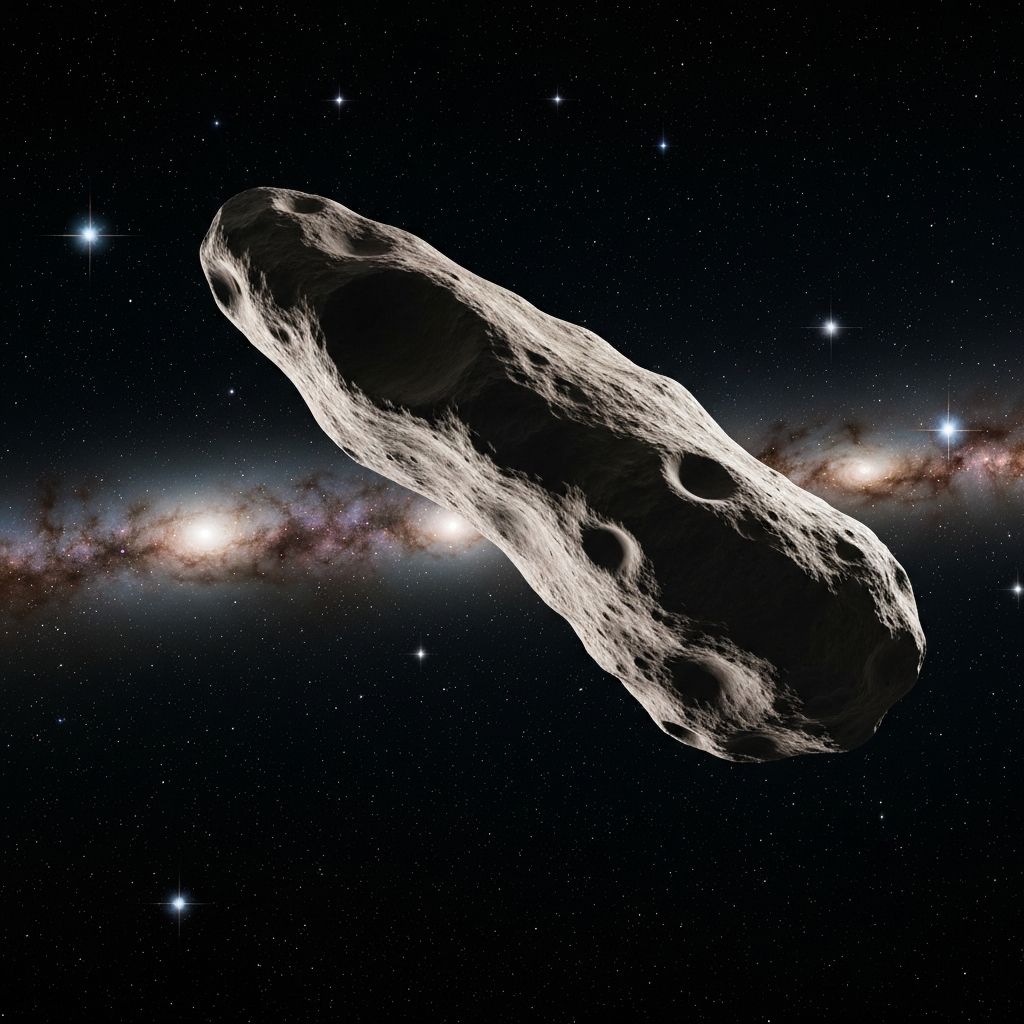
At closest approach, Apophis will shine at magnitude 3.1 — comparable to the stars in the Big Dipper and approximately three times dimmer than Polaris. It will appear as a star-like point of light, not a streak, moving noticeably against the background stars.
The angular diameter will be roughly 2 arcseconds — about the same as Neptune appears from Earth. While this is too small to resolve with the naked eye, adaptive optics systems on professional telescopes will easily capture detailed images. The angular speed will reach up to 42° per hour at closest approach — roughly eight full Moon widths per minute. This is much slower than the International Space Station but fast enough to see motion in real time.
Appearance at Closest Approach
- Peak magnitude: 3.1
- Angular diameter: ~2 arcseconds
- Angular speed: Up to 42°/hour
- Appearance: Star-like point
- Moon phase: New Moon (dark skies)
The Lunar Encounter
Approximately 17 hours after closest Earth approach — around 14:32 UTC on April 14, 2029 — Apophis will pass the Moon at a distance of about 95,000-96,000 kilometers from the lunar surface. While not as dramatic as the Earth encounter, this creates unique opportunities for lunar-based observations and provides additional data points for refining our understanding of the asteroid's trajectory.
A Once-in-History Event
This will be the first time in recorded human history that an asteroid of this size passes this close to Earth — and the first ever when humans have the technology to observe and study it in detail. The combination of proximity, visibility, and scientific readiness makes April 13, 2029, a historic milestone in planetary science.
Scientific Opportunity
The 2029 flyby represents an unprecedented scientific opportunity. Ground-based radar facilities like Goldstone and Green Bank (in the US) and Canberra DSS-43 (in Australia) will conduct intensive imaging campaigns. Optical telescopes worldwide will perform photometry, astrometry, and spectroscopy. Space-based platforms will contribute observations from unique vantage points.
Two spacecraft missions — ESA's Ramses (arriving before the flyby) and NASA's OSIRIS-APEX (arriving after) — will provide close-up "before-and-after" observations, creating the first complete dataset of how a close planetary encounter affects an asteroid. The International Asteroid Warning Network (IAWN) is coordinating citizen science participation, allowing amateur astronomers to contribute to this historic observation campaign.