The Aten-Class Orbit
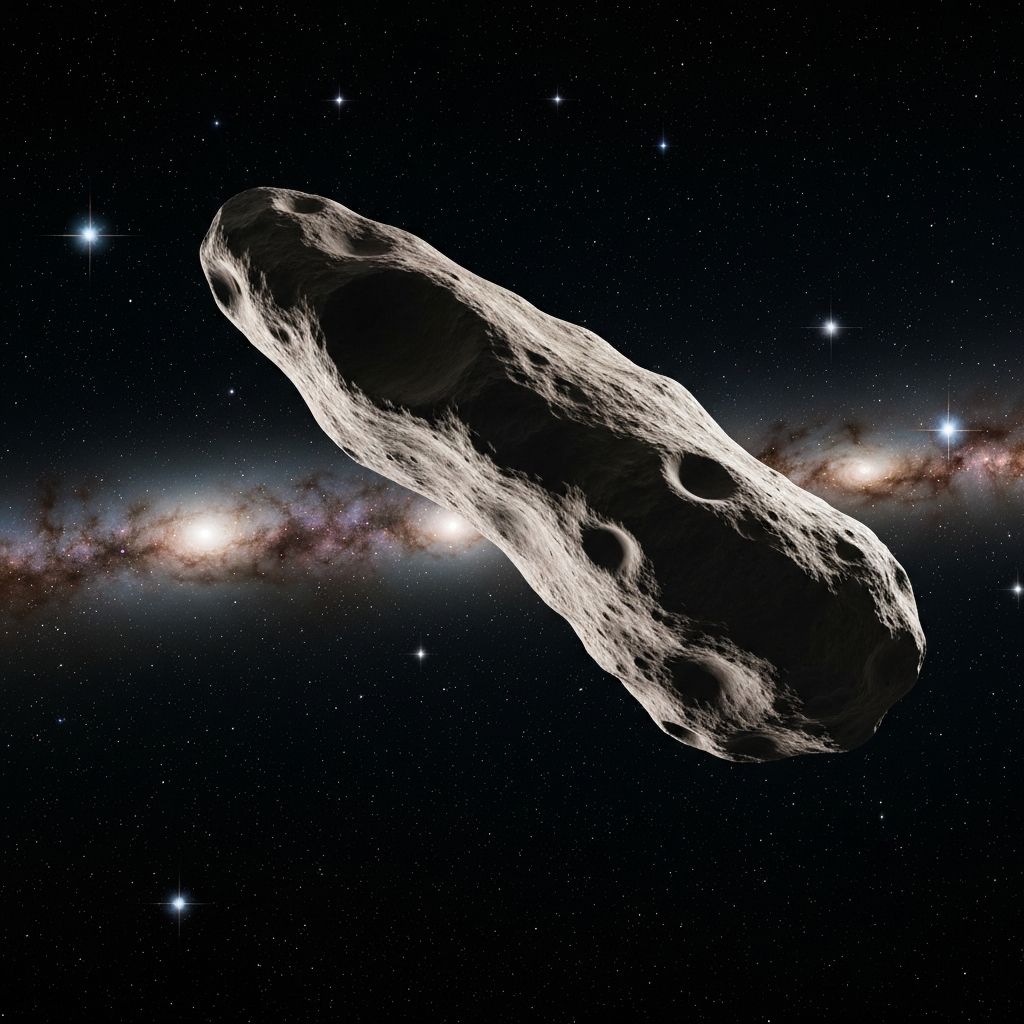
Apophis follows an Aten-class orbit, meaning its orbital path is mostly inside Earth's orbit around the Sun. With a semi-major axis of just 0.9227 AU (compared to Earth's 1 AU), Apophis completes its journey around the Sun in only 323.6 days — roughly 0.89 Earth years. This means Apophis effectively "laps" Earth approximately every 8 years, creating opportunities for close encounters.
The asteroid's orbit is moderately elliptical, with an eccentricity of 0.191. At perihelion (its closest point to the Sun), Apophis ventures to 0.746 AU — just outside Venus's orbit. At aphelion (farthest from the Sun), it reaches 1.099 AU, barely crossing Earth's orbital distance. With an inclination of only 3.34° relative to Earth's orbital plane, Apophis's path is nearly flat, making geometric coincidences with Earth more likely.
Pre-2029 Orbital Parameters
- Semi-major axis: 0.9227 AU
- Orbital period: 323.6 days
- Eccentricity: 0.191
- Inclination: 3.34°
- Perihelion: 0.746 AU
- Aphelion: 1.099 AU
The Ascending Node Coincidence
The 2029 close encounter occurs because of a remarkable geometric coincidence: Apophis's ascending node — the point where it crosses Earth's orbital plane from south to north — happens very close to where Earth is positioned on April 13 of any given year. This is why close encounters with Apophis historically cluster around mid-April.
Because of this orbital geometry, Apophis approaches Earth roughly every 7.75 years on average. Between April 1998 and April 2029, there have been four close approaches. These encounters tend to occur between December and April when Apophis is in the outer portions of its elliptical orbit, increasing the likelihood of Earth-crossing scenarios.
The 2029 Encounter Geometry
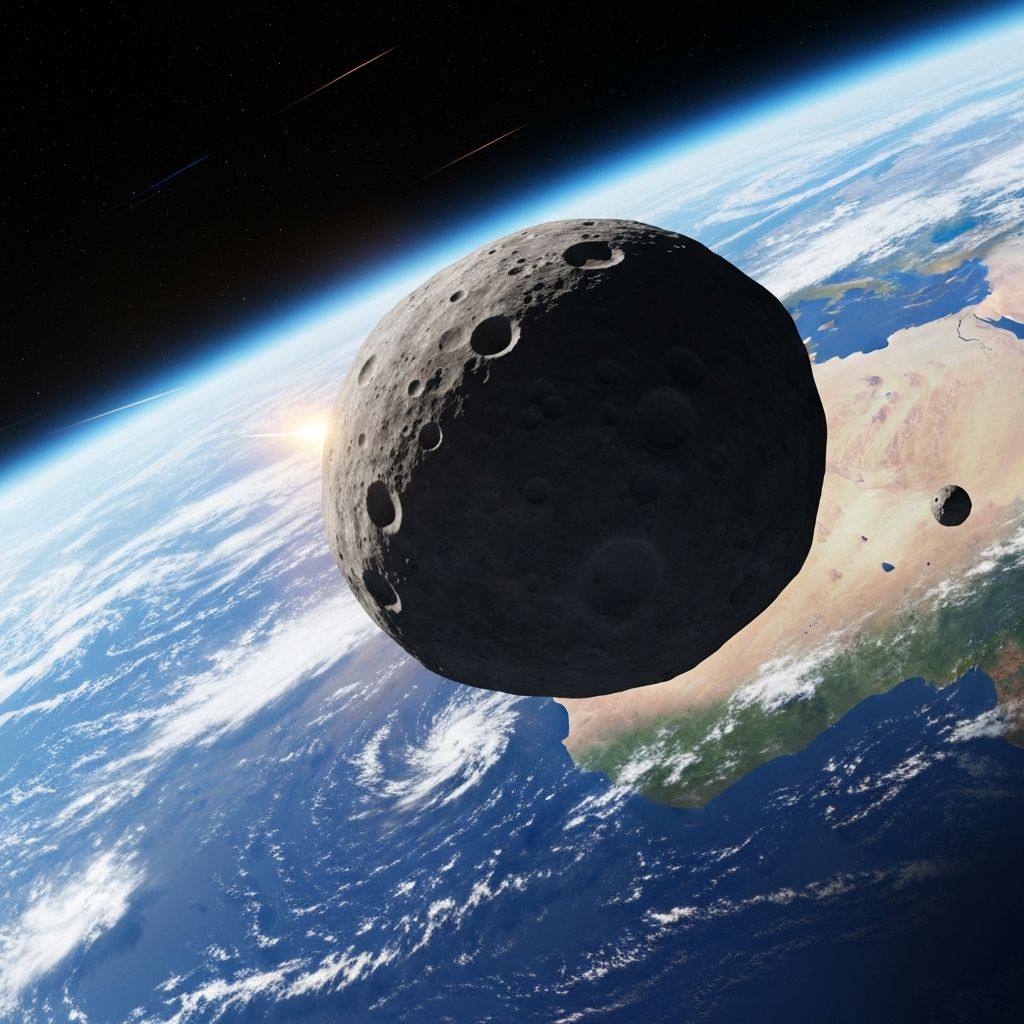
During the 2029 flyby, Apophis will follow a hyperbolic trajectory relative to Earth — the same type of curved path used by spacecraft during gravity-assist maneuvers. The asteroid will approach from Earth's night side, flying toward the Sun at a 40° inclination to Earth's equatorial plane.
Approximately 80 minutes before closest approach, Apophis will cross the equatorial plane. The asteroid will spend about 34.3 hours within the Moon's orbital radius, with its perigee altitude ranging between 29,500 and 33,800 kilometers — the best estimate being 31,600 km above Earth's surface.
Velocity Profile
- Approach Velocity: 6.0 km/s relative to Earth
- At Closest Point: 7.4 km/s (gravity accelerated)
- Equivalent ΔV: ~2.8 km/s (like spacecraft assist)
A Permanent Transformation
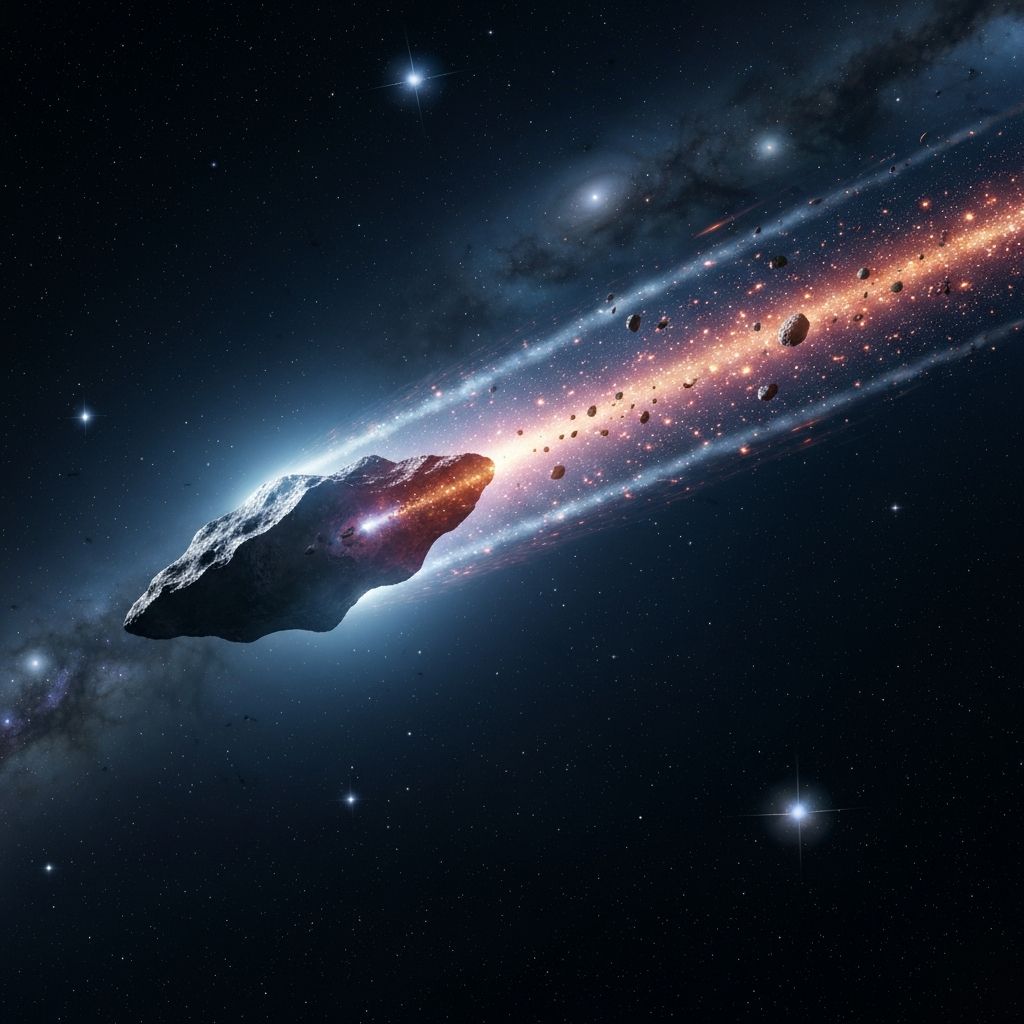
The 2029 flyby will permanently alter Apophis's orbit through a gravitational interaction so powerful it's equivalent to a spacecraft gravity assist. Earth's gravity will essentially "kick" the asteroid into a wider orbit, transforming it from an Aten-class to an Apollo-class asteroid.
"The 2029 encounter will change Apophis's orbital period from 323.6 days to approximately 428 days — a transformation so significant that the asteroid will shift from an interior orbit to one that extends well beyond Earth's path."
— NASA Jet Propulsion Laboratory
After 2029, Apophis's semi-major axis will increase from 0.92 AU to approximately 1.1 AU, and its perihelion will shift outward from 0.746 AU to 0.895 AU. The aphelion will extend to 1.31 AU, taking the asteroid farther from the Sun than ever before in its current orbital configuration.
This transformation means Apophis will still have close encounters with Earth's April 13 position in the future, but will also pass near Earth's mid-September position instead of mid-December. The next significant close approach after 2029 won't occur until April 2051 at approximately 6 million kilometers, followed by April 2116 at about 3 million kilometers.
The Yarkovsky Effect
One of the most critical factors in predicting Apophis's trajectory is the Yarkovsky effect — a subtle non-gravitational force that has profound long-term implications. When sunlight heats one side of a rotating asteroid, that side radiates thermal energy as infrared heat when it turns away from the Sun. This uneven thermal emission produces a tiny but persistent thrust.
For Apophis, which rotates in a retrograde direction (opposite to its orbital motion), this effect causes an inward spiral toward the Sun. Astronomers David Tholen and Davide Farnocchia first measured this drift in March 2020, determining that Apophis's semi-major axis shrinks by 170–199 meters per year — a measurement crucial for eliminating long-term impact scenarios for the next century.
Post-2029 Uncertainty
After the 2029 encounter, the Yarkovsky effect will change because Apophis's average distance from the Sun increases. The new thermal dynamics cannot be accurately predicted until post-2029 observations are made by OSIRIS-APEX and Ramses missions. This is why long-range predictions beyond 2100 carry increasing uncertainty.
Unprecedented Precision
Thanks to two decades of optical and radar observations from facilities like Goldstone, Green Bank, and the now-retired Arecibo Observatory, astronomers have achieved extraordinary precision in Apophis's trajectory. As of June 2024, the uncertainty in the 2029 approach distance has been reduced from hundreds of kilometers to just ±3.3 kilometers (3-sigma confidence).
This remarkable achievement — tracking an object 340 meters wide over distances of millions of kilometers with meter-level precision — is why scientists can confidently state there's no impact risk for at least 100 years. It represents one of the greatest triumphs of modern astrometry and planetary defense.