The Invisible Force Reshaping Orbits
In March 2020, astronomers David Tholen and Davide Farnocchia made a discovery that fundamentally changed our understanding of Apophis's trajectory. Using observations from the Subaru Telescope in Hawaii, they detected something invisible yet powerful: the asteroid was drifting toward the Sun by 170 meters every year — not because of gravity, but because of sunlight itself.
This phenomenon, called the Yarkovsky effect, is one of the most subtle yet significant forces affecting asteroid orbits. Without accounting for it, long-term predictions of Apophis's path would be off by thousands of kilometers. Understanding this effect was the final piece of the puzzle that allowed NASA to definitively rule out any impact risk for at least the next 100 years.
The Yarkovsky effect reminds us that in space, even the gentlest forces matter when given enough time.
What is the Yarkovsky Effect?
The Yarkovsky effect is a non-gravitational force caused by the thermal radiation of sunlight absorbed and re-emitted by a rotating asteroid. Named after Russian civil engineer Ivan Osipovich Yarkovsky, who first described the concept in the 1900s, this effect arises from an elegant physical principle: when an asteroid absorbs sunlight, it doesn't radiate that heat evenly.
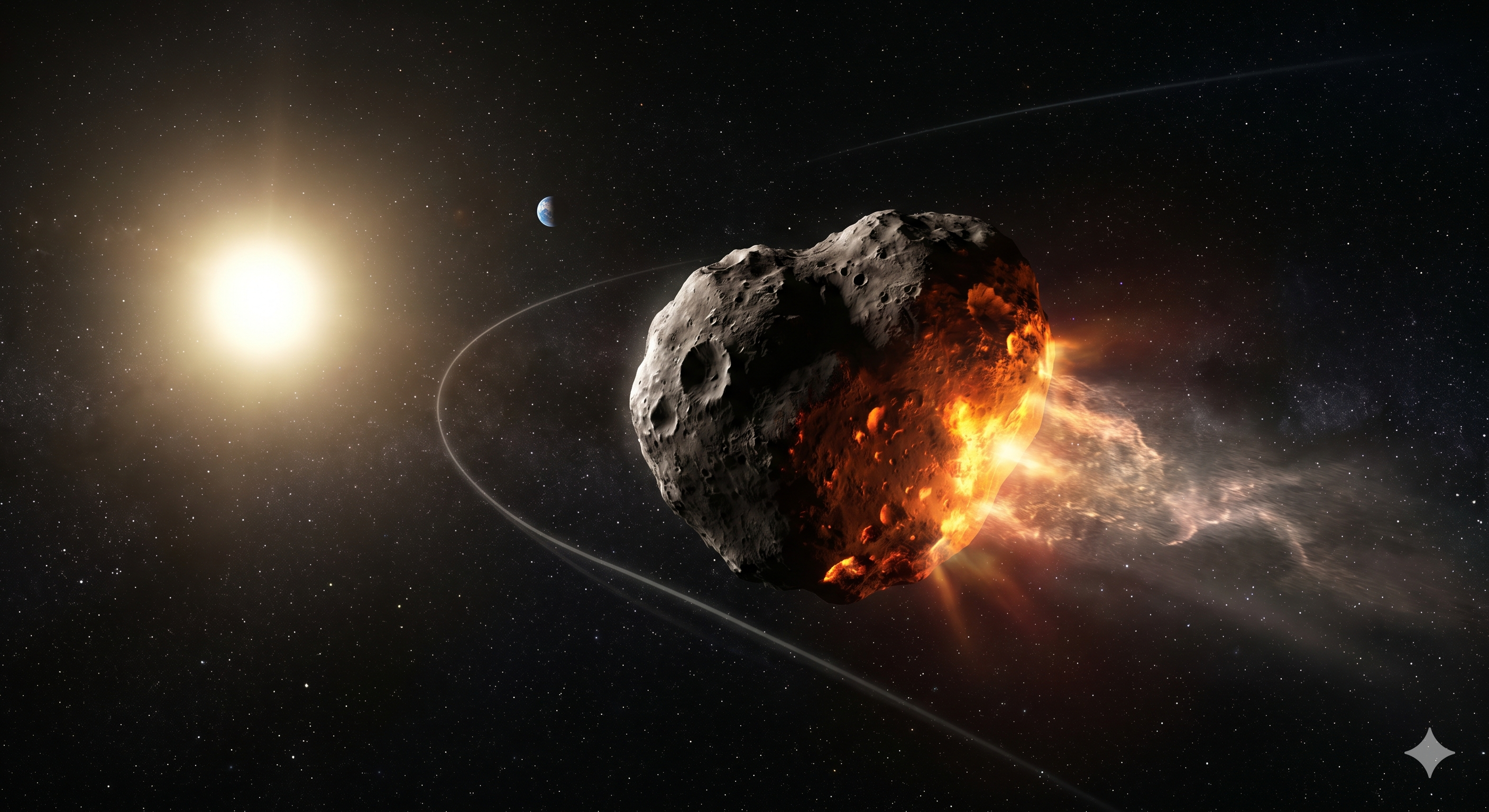
Here's how it works. As an asteroid rotates, the side facing the Sun heats up during the "afternoon." When that heated surface rotates away from the Sun into the "evening" and "night" positions, it radiates thermal energy as infrared photons. This thermal emission carries momentum — and just as a rocket produces thrust by expelling exhaust, an asteroid experiences a tiny push from its own heat radiation.
The Rocket That Doesn't Burn Fuel
Every photon of infrared light carries momentum. When trillions of photons are emitted from a rotating asteroid's surface, they collectively produce thrust. For Apophis, this creates a continuous acceleration of approximately 10⁻¹⁰ m/s² — one ten-billionth the strength of Earth's gravity. Yet over decades, this minuscule force causes the orbit to drift by hundreds of meters per year.
The direction of this thermal thrust depends on the asteroid's rotation. If an asteroid rotates in the same direction as its orbit (prograde rotation), the hottest surface lags behind the direction to the Sun, pushing the asteroid outward and increasing its orbit. If it rotates backward relative to its orbit (retrograde rotation), the effect reverses, causing the orbit to shrink.
How the Yarkovsky Effect Affects Apophis
Apophis rotates in a retrograde direction — it spins backward compared to its orbital motion around the Sun. This means the Yarkovsky effect causes the asteroid to spiral slowly inward toward the Sun, shrinking its semi-major axis by 170 to 199 meters per year.
This might sound insignificant, but consider the timescales involved. Over the 20 years between 2004 and 2024, the Yarkovsky effect caused Apophis's orbit to shift by approximately 3,400 to 4,000 meters — more than the length of the asteroid itself. Over a century, this drift accumulates to 17 to 20 kilometers. When you're predicting where an asteroid will be decades in the future, every kilometer matters.
Detecting the Drift
Measuring the Yarkovsky effect on Apophis required extraordinary precision. Tholen and Farnocchia analyzed optical observations spanning 16 years, comparing predicted positions based purely on gravitational forces to the asteroid's actual observed locations. The discrepancy revealed a consistent drift pattern that could only be explained by thermal forces.
"The Yarkovsky effect on Apophis is about the force you'd feel if you held a single grain of sand. But that grain of sand, pushing for decades, moves an asteroid weighing 27 million tons."
— Davide Farnocchia, NASA Jet Propulsion Laboratory
This measurement was groundbreaking. It eliminated the tiny but non-zero possibility that Apophis could pass through a gravitational "keyhole" during the 2029 flyby — a narrow region of space that would have set up a potential impact in 2068. With the Yarkovsky drift precisely measured, NASA could definitively state: Apophis poses no threat for at least 100 years.
Why This Tiny Force Matters for Orbit Predictions
Traditional asteroid trajectory predictions rely on gravitational forces: the pull of the Sun, planets, and even other asteroids. These forces are powerful and well-understood, governed by Newton's laws and Einstein's general relativity. But for asteroids on long timescales, gravity alone isn't enough.
The Yarkovsky effect introduces an additional variable that depends on the asteroid's physical properties — its size, shape, rotation rate, thermal properties, and surface reflectivity (albedo). Small changes in any of these factors alter the strength and direction of the thermal thrust.
The Uncertainty Problem
Without including the Yarkovsky effect, trajectory predictions diverge rapidly from reality. For Apophis, neglecting this force would have resulted in position errors of tens of thousands of kilometers by 2068. That's the difference between predicting a safe passage and an uncertain close approach.
| Factor | Impact on Yarkovsky Effect |
|---|---|
| Rotation direction | Determines inward vs. outward drift |
| Rotation rate | Faster rotation = smaller effect |
| Surface temperature | Hotter surface = stronger thrust |
| Thermal inertia | Affects thermal lag angle |
| Size | Smaller asteroids feel stronger effect |
| Albedo | Lower reflectivity = more absorbed heat |
For Apophis, astronomers had to account for its unusual non-principal axis rotation (tumbling motion), its bilobed shape, and its relatively low albedo. Each of these factors influences how sunlight is absorbed and re-radiated, making the Yarkovsky calculation complex but essential.
The 2029 Flyby and the Yarkovsky Reset
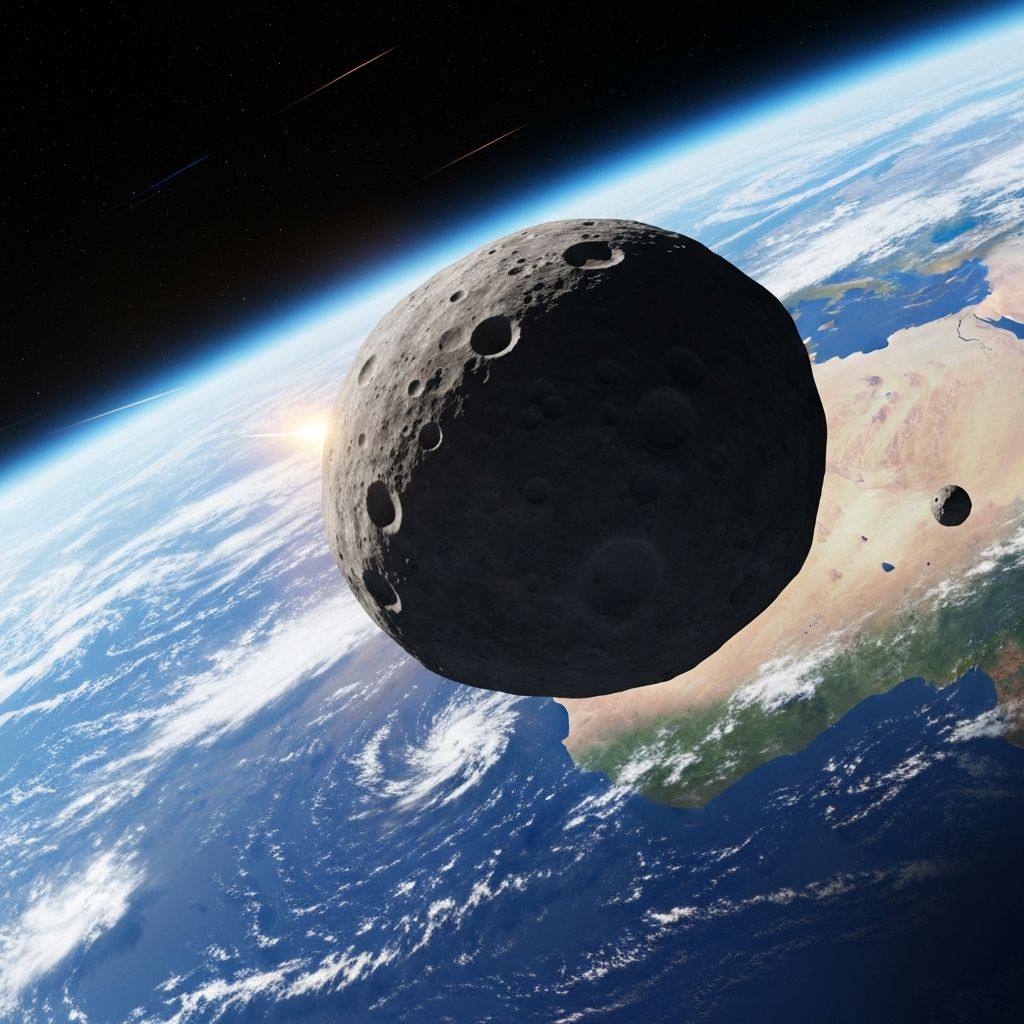
The 2029 close encounter with Earth will fundamentally change everything we know about Apophis's Yarkovsky drift. When the asteroid passes just 31,600 kilometers above Earth's surface, it will experience forces that could alter its physical properties in ways that directly affect thermal radiation.
Earth's intense gravitational field may trigger "asteroid-quakes" that could cause surface landslides, expose fresh material, or even change the asteroid's rotation state. Any of these changes would alter the Yarkovsky effect's strength and direction after 2029.
The Great Yarkovsky Unknown
After the 2029 flyby, Apophis will have a larger semi-major axis, meaning it will orbit farther from the Sun on average. Greater distance means less intense sunlight, which reduces the Yarkovsky effect's strength. However, if the encounter alters Apophis's rotation, shape, or surface properties, the effect could change in unpredictable ways. This is why OSIRIS-APEX and Ramses missions will carefully measure Apophis's post-flyby physical state.
This uncertainty is precisely why NASA and ESA are sending spacecraft to observe Apophis before and after the 2029 encounter. ESA's Ramses mission will arrive in February 2029 to establish "before" measurements of the asteroid's rotation, shape, and thermal properties. NASA's OSIRIS-APEX will arrive after the flyby to document any changes and measure the new Yarkovsky drift rate.
These measurements will be critical for predicting Apophis's trajectory beyond 2050, when the accumulated effects of post-2029 Yarkovsky drift will begin to significantly influence close approach distances.
Beyond Apophis: The Broader Implications
The Yarkovsky effect isn't unique to Apophis — it affects every asteroid in the solar system, especially smaller ones. For asteroids less than a few kilometers in diameter, this thermal force can be the dominant non-gravitational perturbation, gradually altering orbits over millions of years.
Understanding the Yarkovsky effect has profound implications for planetary defense. Any future deflection mission would need to account for how changing an asteroid's orbit or rotation also changes its thermal radiation pattern, potentially altering its future trajectory in unexpected ways.
The effect also helps explain the gradual delivery of meteorites to Earth. Many meteorites originate in the main asteroid belt between Mars and Jupiter. Collisions create fragments, and the Yarkovsky effect slowly pushes these fragments into orbital resonances that eventually send them toward the inner solar system.
Measuring Success
Apophis represents one of the best-measured examples of the Yarkovsky effect on any asteroid. The precision achieved — detecting a drift of just 170 meters per year on an object millions of kilometers away — demonstrates the extraordinary capability of modern astrometry.
This level of precision required combining optical observations from telescopes worldwide with radar measurements from facilities like Goldstone and the now-retired Arecibo Observatory. It represents decades of patient observation, meticulous data analysis, and sophisticated modeling.
The Takeaway: Patience and Precision
The story of the Yarkovsky effect on Apophis is ultimately a story about the power of patient observation. It took 16 years of tracking a 340-meter asteroid across the solar system to detect a force equivalent to the weight of a single grain of sand.
That same patience and precision transformed Apophis from an object of concern into a well-understood scientific opportunity. By measuring forces so subtle they would be imperceptible on human timescales, scientists eliminated impact scenarios a century in the future.
The 2029 flyby will mark the beginning of a new chapter in understanding Apophis's Yarkovsky drift. With two spacecraft missions and ground-based observatories watching every kilometer of the asteroid's journey, we'll gain unprecedented insight into how thermal forces shape asteroid orbits — and how to predict them with the accuracy needed for planetary defense.
In space, sunlight doesn't just illuminate. It pushes, it drifts, it changes orbits. And thanks to the Yarkovsky effect, we can now measure and predict those changes with remarkable precision.